Showing posts with label consumerism. Show all posts

Wednesday, December 21, 2016

Something About Winter...

So, Bellingham has just emerged from a week-and-a-half long deep freeze, complete with snow and ice, barely drive-able roads, and requisite traffic accidents.

Is it weird that I was made homesick?

New York is one of the great winter cities in the country.  Yes, I am biased a bit, but hear me out.  New York has earned a reputation for being a rough place, filled with blunt, rude people who will run you over if you get in their way.  It's a crucible that takes the weak-minded, undisciplined, and poor and either forge them into something stronger, or kills them under the weight and pressure of living there.  Some of that rep is justified, some isn't.  It's not up to me to sift through which is which.

However, for the six weeks between Thanksgiving and New Year's Eve, the city softens a bit.  Maybe it's the brainwashing from all the holiday music that yo hear from every place that has a speaker, but for that time, it never seemed as bad.  People were generally nicer to one another.  Kindness was seen on the surface.  As people geared up for the season, you could see it, feel it, a particular and unique kind of spirit.

It's the same as in small towns, when you see a kid's face light up as they meet Santa (TM) for the first time.  The big city is no different.  The Salvation Army still rings bells at every street corner, and people still drop their spare change into the big red pots.  Lights are strung up from every lamppost, intersections are made more festive.  Storefronts put up amazing displays.  And while NYC does it on an entirely different scale...


... it's still Christmas.  Or Hanukkah.   Or whatever you want to call it.

Don't get me wrong, New York in the dead of winter offers bone-chilling temperatures, schizophrenic weather patterns, and sometimes a kind of bleak that there isn't a word for, but for those six weeks, that specific time of year, it doesn't seem half bad.

Tuesday, January 12, 2016

The Billion-Dollar (Day)Dream

Powerball is at $1.3 billion for Wednesday's drawing, and if you're like me, you've got most of it spent already,  what with the homes you would buy and friends and family you would help or avoid.  Some would see the world, others would invest in a solid gold bathtub (because, you know, gold is a stable investment).  And I would love for you all to comment on what you would do in the comments section down below.

Personally, I would send all my inner circle an email to go to the airport at a specific time.  There would be a ticket waiting for them.  And we would go on one EPIC adventure.  After that was done, though, it would be time to make that money work for me.  I may be crazy, and I'm definitely not a finance guy, but here's what I would do.

First, I would move my family (brothers and sisters, nephews and nieces) to one place, where we would own a block off homes, or a cul-de-sac or something.  Thomas Town would be born.

Next, I would set up my nephews and nieces with independent million dollar trust funds, untouchable until they turn 21.

I would section off an enormous amount to simply accrue interest.

I would then start Thomas Holdings, Ltd as a way to allot the money in a manner that it would never be completely depleted.  This company would be the way I did real estate back home (more on that later), do an entertainment startup, or any number of ventures that two or three hundred million would allow.  I would have the holding company pay me and my family a salary (to at least give the illusion that there should be some degree of responsibility for one's own money) and live.

The real estate thing is a big deal to me, as it would be my way of giving back to my hometown.  I'm from Brooklyn, NY (as most of you know), and grew up in Flatbush, one of the neighborhood that is at the center of the big gentrification issues going on back home.  While it may be all Starbucks and hipster now, when I was there it was affordable, low-to-middle income housing (the 'hood).  Some of my greatest friendships were forged there, some of my best memories happened there, and some of the best stories that can't be told start and end there.  If you go to my closest circle of friends and say the words "Silencio del Gato," they will smile, laugh... and bite the cyanide pill in their teeth to avoid revealing secrets (we take that seriously).  But I digress.

New York as a whole, Brooklyn in particular, has become inaccessible for the most part to the low-to-middle income citizen, despite that being the vast majority of the city.  Ask any one of the five co-workers sharing a two-bedroom, 950 sq. ft. apartment in Bed-Stuy or Sunset Park, and paying a grand.  Each.  What I would do is, starting with the block I grew up on, buy some of the older buildings, renovate them, and rent them out to low-to-middle income families.  Not the projects, but actual livable apartments.  With reasonable square footage.  That didn't demand 75% of your earnings to simply keep a roof over your head.  There are some that would regard this as a bleeding-heart fantasy devoid of any business sense, but I disagree.  Yes, can cater to the high-end and make large sums of money, but there are more people two or three tiers down than there are at the top, and that is a huge market in NYC.  With a little less than a billion dollars in the bank, profit wouldn't be my primary motivation, but it would generate income nonetheless.

It's a billion-dollar fantasy that makes me smile.  And if my $20 pulls that in and makes that fantasy a reality, how cool would that be?

But hey, it's the lottery.  I might as well ask Santa Claus to make that happen.

Feel free to comment with your daydreams and money wishes.  Cheers!

Side note:  I'd be remiss if I didn't give a shout out to the late David Bowie.  Along with Madonna, he was the master of innovation and reinvention, both stylistically and musically.  You've gotta hand it to a man who managed to stay relevant since the mid-70s.  RIP, Mr. Bowie.

Thursday, October 15, 2015

Adulting

Some days I think Peter Pan got it right.

Screw adulthood.  I want to play and not worry about time.  I want to have all my needs taken care of for me and not have to think about employment or taxes or any of that stuff.  Who needs to think about politics and religion and love and feelings?


It seems the difficult stuff was never in the manual.  Parents would offer vague warnings about savoring our youth and enjoying simplicity without directly stating what about adulthood sucked so much.  All we saw was a life free from stupid rules and chores and stuff.  So many of us were not schooled on the responsibility adulthood carries.  We were told bits and pieces, educated in math and science and history, but we weren't prepared for this life of bill payment and maintenance.  We were told that we were special, that we had something to offer the world.  Who would have thought they were merely referring to our time?

It was a conversation I had briefly with my sister-in-law on her birthday earlier this week.  Adulthood carries the responsibility of time management, of child rearing, of management of emotions, of deferring happiness for the sake of the bigger picture.  If I had that information at 8 or 9 years old, it would have been a one-way ticket to Neverland.  I'd have taken my chances with the Pirates.  We do grow up though.  It's not a process we can opt out of.  We do what we have to to accomplish what we want to.  Dreams are tailored to fit the reality of the the world around us, the world we wish to change.

If we're lucky, we are either born with or developing the skills we need to affect that change.

***

I never thought I'd live in a world where the Mets, Cubs, and Blue Jays are in the running for a World Series at the same time.  Meanwhile, my beloved Yankees are watching from home.  I'm not okay with this.

***
My grandmother's 96th birthday just passes.  Am I wrong to hope she can double it?

Thursday, August 20, 2015

Not These Fools Again, Part 2 (Vacation Day Five: Marine Park, Brooklyn, NYC and JFK airport: 8/8/2015)

I'm a little late for posting.  Sorry about that.  Where was I...?

Oh, right.

After a night of revelry and memories and drinks and bro-hugs, I was due to fly to London the next evening.  I was to meet my girlfriend's father and cousins who for two years, I have heard plenty about.  However, there was still a bit of unfinished business.

My friends were the inspiration for my first novel.  We're a tight-knit crew that can number anywhere between 4 and 12 depending on the day.  Well, this beautifully warm Brooklyn Saturday morning, there were to be four of us, Eric, Mikey, LeAnder and myself.  We used to gather together and hang out all the time.  The awkward times of childhood were spent with these guys,

I made my way across Brooklyn to LeAnder's place.  He still lived in the old neighborhood, and it was the closest I felt to actually being home since forever.  I hadn't spoken to him in quite some time, life getting in the way and all that, but it was like we never missed a beat. Thirty years of friendship will do that.  He caught me up on the happenings in the old neighborhood, who died, who moved and such.

Mikey drove up from North Carolina to join us.  He'd been there for the last few years, having grown weary of the crucible that is New York City.  Obviously, I can't blame him.  We had a few jokes, the three of us, and after a quick detour to Modell's to buy a basketball, we were off to Marine Park to meet up with Eric and do something we hadn't done in forever.  Playground ball, king of the court style.

Well, eventually.  We were all various degrees of rusty.  I hadn't played in a few weeks, and the rest of those guys hadn't played in much longer.  Eric was recovering from knee injuries.  LeAnder hadn't touched his ball shoes in the last two summers.  Mikey hadn't been on a basketball court in who knows how long.  We decided to warm up with a game of Utah.  Short explanation: one-on-all, score by fives, first to 100 wins.  We rarely ever made it to 100 when we played together back in the day because there were usually enough people on the sideline waiting to play, and we usually looked good enough on the court to make people think we'd play a good game.

Not the case this time.  This time, we all looked old.

It took me about 20 minutes to get my wind up, but the rest of my friends never quite got there.  LeAnder used to be the best all-around athlete of all of us, and he was gassed.  Eric used to be an And-1 quality street point guard, but his knee problems kept him from getting into second gear.  And Mikey, who used to be Mr. Indestructible, hurt his back before we even finished.  It used to be we'd display our skills bad get a game from the stragglers.  Today, we were just a bunch of old guys.  We laughed at that.

I called next for a game on another court for those of us that were able to play.  Mikey was incapacitated, but the Eric and Lee were good to go.  We picked up a fourth and we gave it a good go, but we lost 13-9.  And then we left.  On the way home we remarked about how we went from 6 hours a day on the court in the summer to one-and-done.

Our next stop in the nostalgia tour was our favorite Chinese restaurant, Cam Tak Express on Flatbush Avenue and Cortelyou Road.  It had long ago earned legendary status for being something kids like us could afford on a five-dollar bill, as well as for the Garlic Chicken.  They don't capitalize it on the menu, but dammit, it needs to be immortalized.  We went and we ordered Garlic Chicken and Pork Fried Rice.  It was greasy and crispy and spicy and bad for us, but dammit, we were all thrilled.

We lingered in the restaurant as long as we could but we couldn't escape the reality that this little reunion had to end soon.  I had a plane to catch, people had responsibilities.  Mikey was kind enough to give me a lift to my sister's and then to the airport, prolonging our chat, but all good things must come to an end.

All that was left was a  seven hour flight to London.

Wednesday, August 6, 2014

Retrospective on The Fab 5

I have a confession to make.

Over the last three or four years I've been distancing myself from my first novel, The Fab 5.  I had what I thought was a good reason.  My grandmother, 84 years old at the time, read it.

The Fab 5.  Available on Amazon and B&N.


I never intended for her to read it.  I didn't write it for her.  And it never occurred to me for even a half a second that she would.  It's a street-flavored basketball story following five lifelong friends from Flatbush.  So when I wrote about some of the realities of living in a neighborhood not too dissimilar from the one in which I grew up, there was a heavy dose of, shall we say, colorful language.

                         Castillo’s face went purple, and I swear I saw steam come out of his ears. “Yo,
                   f*** you, you b****-a** monkey n****!”
                          Shiver stood up straight, shocked by the comment. He got right in between
                   Jay and Castillo, getting nearly nose-to-nose with him. “What did you say?”
                   Shiver said, as angry as I had ever seen him.
                          Jay forced his way back in between Shiver and Castillo, and forced them both
                    back. He held Shiver back, and turned to face the Puerto Rican kid. “F*** it,” he
                    said with a heavy sigh. “Get your squad together, Miguel.” Shiver stopped resisting,
                    and joined the four of us in a shocked look at Jay. “If it’s gonna shut his little
                    punk a** up, then fine, let’s beat him again.”
                         Castillo smiled as he walked past Jay. “Don’t go nowhere,” he said as he
                   walked toward the other side of the park. As he walked past Shiver, he said under
                   his breath, “B**** n****.”

And so on.  That is from page 18.  While some people were able to relate to and even appreciate the authenticity of the language -- if you grew up in a rougher neighborhood in New York, I suppose you would too -- I had some friends tell me they created the first literary drinking game in history for every time I swore in that book.  

Up until that point, the only book my grandmother had ever read was the Bible.  Sure, she read newspapers and magazines and such, but The Bible was all she read that came in a hardcover or paperback.  For the record, she still has both.  She had never read a novel.  

Until her youngest grandson gave her a signed copy of The Fab 5.

So several weeks later, when I did my good grandson thing and visited her after work, she looked at me sternly through her glasses like she always did and said in a thick Jamaican accent, "I read your book, Franklyn."  And suddenly every cuss word I wrote, every questionable situation I conceived flooded my head.  I mean, I referred to a certain female character in the five most unflattering ways you could in one line.  (I guess the fact that no word in that line was more than five letters can be considered impressive, if you squint one eye.)

My mouth hit the ground.   "You read it?!  Jeez, Mama, you weren't actually supposed to read the thing!"  I composed myself and cleared my throat.  "So what'd you think?"

She turned her attention to the word search puzzle she was doing and let the question hang for a while.  "I liked it," she said, I'm sure to be polite.  "Too many bad words though."

And just like that, my enthusiasm for promoting my first novel kind of tanked.  I was embarrassed that my grandmother read it.  There's no way there's a market for this thing, I thought.  And that was that.

Fast-forward to 2014.  I'm scrolling through Netflix and stumble across a documentary by Bobbito Garcia called Doin' It In the Park, which followed the streetball scene in the five boroughs, and suddenly I realize exactly how wrong I was.  Bobbito's respect for the sport that I played and loved was oozing from the film, and I saw elements of my book -- the gamesmanship, the competition, the trash-talking, the court culture and such-- played out in reality and motion.

I realized then that The Fab 5 did have value, and did have a market.  Was it perfect?  Not by any means. It's not even my best work; my second novel is leaps and bounds better, and all writers criticize their previous projects.  But it was an accurate depiction of what my world was like at 16, 17, and 18.  You had the park.  You had your crew.  You had a ball.

I may be more actively promoting my current novel, The Favorite, but my earlier work is (in my very humble and obviously biased opinion) very much worth the read.

And keep a bottle of Jack nearby in case you want to play the drinking game.

Tuesday, May 6, 2014

Including The Sun/The Dream and The Reality

First of all, yes, this is the same blog.

I decided on a little facelift, within the confines of my web design ability.  Meaning I looked at the Settings tab to see what Google would let a novice like me do.  So the color palette has been brightened, and it looks kind of like a sunny day.  Because, you know, Under The Sun.

It was either that or change the name to "Through The Black."  Which some people might think to be racist.

***

When I decided that writing was what I was going to eventually do with my life, I had this vision in my head of it being not unlike the creative writing and journalism classes I took throughout high school and college.  Publishers, intellectuals, professors and high school English teachers alike would laud and praise my work, it would be consumed by the masses in quantities unheard of, and I would not only achieve fame and fortune but I would usher in a new era of world peace.  And I'd have groupies at coffee shop readings, because Sean Connery in Finding Forrester said so.


As an adult, the reality was a bit different.  My first novel was rejected out of hand by two dozen publishers, big and small, often without any word that they'd even opened the proposal.  The nerve of them, I thought, impeding my path to wealth and glory with their small-mindedness.  I chose to self-publish.

In the early 2000's, just before Kindle existed, conversations about publishing went like this:

"Oh, I published my novel?"
"Oh, really? Congratulations!"
"Yeah.  I self-published."
"Oh, really.  Congratulations?"

There were a lot of things that an arrogant 25 year-old tried to do.  First off, I decided that the traditional publishing model was broken.  After doing several hundred hours of very focused searching (the Internet is wonderful for giving you an unbiased base for your bias), I came to the conclusion that the only people making money anymore from publishing were the publishers and the very big name authors, the Dan Browns and Tom Clancys, and unknown writers like myself had little to no shot of breaking in.  The big publishers wouldn't look at you unless you had an agent, and an agent very likely avoided you unless and until you had a deal (I kept one of my agency rejection letters that actually said I should think of them when I secure a deal with a publisher).  I looked at self-publishing -- through iUniverse (as shady as they are, they are useful for what they're useful for)-- as the only way to unleash my genius upon the world.  And The Fab 5 was born.  I completed my book, had my name in print, and all I had to do was sit back and wait for my money to roll in.  My landlord at the time wasn't as fond of the idea and recommended I keep my day job.

With time and distance I realized The Fab 5 wasn't going to make me money.  I was an unknown who hadn't promoted my work at all and had no clue how to do so.  There are life reasons for that I won't get into right now, but anyway.  It was a slap in the face; how could all of those English teachers been wrong?

Fast forward some years, and I've adjusted my expectations.  The Favorite is enjoying a modicum of success, which for me now means more people dig it than not.  And one of the things I've realized is that I have to constantly promote, constantly remind, constantly pitch and sell.  And the truth is, as much of a hassle as it can be, I kind of enjoy it.

I was right about a few things.  The traditional publishing model is broken.  It is reliant on the idea that the big  publishers are the gatekeepers of inclusion into some sort of artsy-fartsy literary club, and the only way to have any sort of legitimacy is by begging for their approval  (I had an iUniverse employee refer to self-publishing as the "minor leagues").  Technology has made them the keyholders to a vacant, dilapidated and overpriced apartment building in a really crappy neighborhood.  Yeah, you could live there, but for the same amount of hassle you could live somewhere else and have more money. 

Wednesday, March 19, 2014

The Best Second Job, Ever. (No, seriously)

I'm at my job right now as a sleep tech with my one patient sleeping like a baby.  While I'm watching this person, I'm scouring the internet, looking for free review websites, looking for pay review websites, looking for bookstores that support indie authors.  I jot down numbers and email addresses and email my new list of people, asking what their indie book policies are, and if they'd be willing to carry my novel.  I'm taking the reviews I do have and cobbling them together in a press kit while cursing myself for not having enough scratch to hire a publicist.  I'm designing flyers for my first (ever) author event and trying to set up more in one of the stores that cautiously agrees to buy one copy of my book as a tester to see if it sells.

When I get off my 12-hour shift at 7:00 in the morning, I go home, try to eat something with at least one healthy ingredient and get back on the internet for another hour.  I send out a few more emails, a few more requests, and obsessively check my inbox for a reply from the previous day, or from earlier in the night.  By 9 I'm wiped and head to bed, but I keep my phone nearby on vibrate so I can hear it when and if someone eventually calls back.  I wake up at 3:00 in the afternoon and call the numbers from the previous night; it's my first opportunity to reach them since they opened while I was sleeping.  I speak to the book buyer, or whomever will actually listen to me, and I pitch them my book.

This is my experience at being an author.  This is my second job.

I'm completely untrained, totally inexperienced, an winging it as I go.  The only instruction I have is a three year old copy of The Indie Author Guide and my own notes as to what hasn't worked.   I'm my own marketing department, sales division, budgetary committee.  I'm my own press room, advertising firm.

It's more of a daunting task than I expected.

So why do it myself?  Why not go the traditional route?  A few reasons.  For starters, the traditional publishing industry has changed dramatically than what you may remember.  I hear stories of authors putting together their own book tours, contacting news media on their own... basically doing everything I'm doing now.  So if the only difference is the name of the company on the spine and the percentage of royalty you get (I hear it's low by the way), then why not do it yourself?

And if the truth were to be known, I rather enjoy it.

For the first time in my adult life, success or failure is completely, expressly in my hands, AND directly affects me.  This isn't like being productive at the desk that we sit behind at work (incidentally, I need to periodically check on my patient while I rant).   In that environment, there is a higher margin for error, and your best efforts make your bosses' bosses' bosses  rich, not you.  I'm happy to know that I only go as far as my abilities take me.  I like this.

Don't get me wrong, I like being a writer more, and there is a distinct difference between the two, but this is great!  I'm getting a list together of today's emails, moving south to see who wants to join Village Books in Bellingham and Edmonds Bookshop (both in Washington, and yes I'm name dropping).  This is the best second job you could have.]

It's about 4:00 AM now.  I've got my new list to create, new numbers to pull, and a flyer design to refine.

Wednesday, February 26, 2014

The Home I Knew Is Gone

Required listening: Spike Lee's "rant" on gentrification in Brooklyn, NY

I grew up in Flatbush and my teen years were spent during the early to mid '90s witnessing firsthand the effects of the crack epidemic and the drug war on a neighborhood.  Shootouts were common and gunfire echoed through the night like a snare drum.  The apartment I grew up in, which my family to some degree still lives in, was cheap for New York, even at the time.  The unfortunate part about New York being built on a series of islands is that there's no space to expand, and the housing market gets competitive and expensive. Years ago, before the war on the lower and middle classes, city planners had the foresight to install rent control and stabilization laws to prevent the laws of supply and demand from cannibalizing the populace.  After all, what's the point of having a good job if you can't afford to live there.  Rudy Giuliani, who won his first term as mayor with the not insubstantial financial backing of the real estate lobby, ended those laws which set in motion the runaway increase in rent in Manhattan, and eventually throughout the city.

Looking back, it's effect has been multi-tiered.  Drive the prices up in Manhattan.  The middle class who were able to live there before are forced to move to the outer boroughs.  But wait, some of those neighborhoods are sketchy and filled with drug addicts and minorities.  That's okay.  Arrest the drug addicts and minorities (in New York in the mid 90's, the NYPD's zero-tolerance policy and propensity for racial profiling made the terms interchangeable), rebrand the neighborhood by changing it's makeup (building more Manhattan-style dwellings and inviting more displaced Manhattanites) and/or by changing it's name to eliminate it's negative connotation (Spanish Harlem becomes SpaHa, the South Bronx becomes SoBro, Bushwick becomes East Williamsburg, and parts of East Flatbush and Flatbush become extensions of Park Slope and Prospect park South).  The rising rents eventually price existing tenants out, and if that doesn't work, the landlords were empowered to let buildings fall into decay until the undesirables moved out, then repair them and rent for full market value.  And slowly, over 20, 30 years, people of color and/or less than extraordinary means are pushed further and further away from the city proper, or shunted into overpriced public housing.

Spike Lee has said some less than brilliant things in the past about race relations that you likely haven't heard if you're not from New York.  His views on gentrification are spot on.  I was priced out of my hometown.  I agree that it shouldn't have taken an influx of wealthier residents to have the city services (Police, Parks, Sanitation, Education) do their jobs in certain neighborhoods.  Trash would pile high and linger on the sidewalk for days (and in the summer, stink like hell) due to once a week trash collection.  Those same neighborhoods are now getting daily collection.  They're getting increased police protection, which is a marked difference from the "contain" mentality of my youth.  And while I don't begrudge anyone the increased service they get, I can't help but feel a little cheated.

Maybe it shouldn't matter to me so much what's going on in New York.  I'm not there anymore, not subject to anything Spike Lee was talking about.  But, I've always had a problem with injustice though, and what we're seeing there is the last bits of a systematic injustice become revealed.  And it saddens me.

UPDATE:  This is purely anecdotal.  I'm going on my own experiences plus what I've observed while I lived in New York and since I left.

Tuesday, January 21, 2014

MLK Day and Richard Sherman (or, Just Because Chris Rock Said It...)


Warning: Graphic content follows.  Words and video are in this blog that are nowhere near appropriate for most people to see, say or hear in public.

I'm not a Seahawks fan, but people are way overreacting to Richard Sherman's post-game interview.  He made a fantastic, game-winning, send-your-team-to-the-Super-Bowl play, and immediately after was interviewed about a play he made on a player he didn't like.    The response has ranged from finger-wagging to just plain shameful.

Before I get into the meat of this post, let's start with the source, in my opinion, of the problem.


In 1996, Chris Rock's HBO special, Bring The Pain, famously and hilariously makes the distinction between black people and "niggas."  I'm a fan of Chris Rock.  At the time, it was kinda-sorta more acceptable for black people to refer to other black people as "nigga," or "my nigga."  The rationale was that we took something that was meant to demean and turned it into a insider thing of respect.  Looking back, that was stupid.  But that's not the point.

Chris Rock's famous rant about "niggas" made a specific distinction between "undesirable elements" and normal black people, and through that distinction made it okay for people to use the word who had no business using the words, and using it for its original purpose to boot.  I got into several conversations with my more melanin-deprived friends on the East Coast in the months and years immediately following that HBO special that went something like this: "I fucking hate niggers, they're lazy and unmotivated and steal my stuff and my girl.  Not you though, you're cool."

No.

Just because Chris Rock said it doesn't make it okay for you to say it.

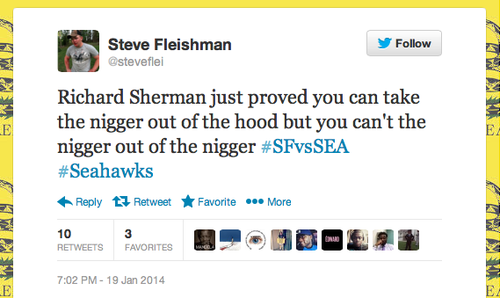
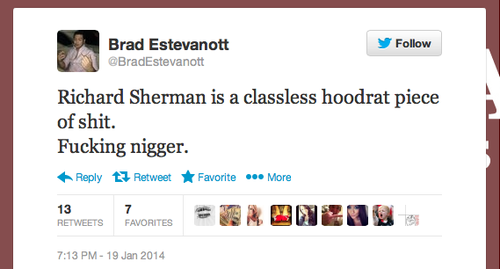
So, flash forward 18 years.  Richard Sherman makes his play.  He has his interview.  Then, on Martin Luther King Jr. Day, comes the internet response.


"
image
Whoa, white dude.  WTF?


image
For the record, Richard Sherman went to Stanford.  As in, Ivy League.  And he was a 3.9 student.  Which means, even by the Chris Rock definition, he's not.


image
Wow.  Speechless.  Stay classy, dude.


You can see the rest here.

By no means is this okay.  The N-word isn't cool.  You don't legitimize your "down" ness by spouting it off at every turn.  And there is no distinction.  We're black people, African-American, not niggers.  You don't distinguish, you demean.  Especially when you call someone who's done things, and is doing things, that you can't.  Such as go from a 3.9 at Stanford to the best cornerback in the NFL.

Chris Rock was wrong.


Sunday, January 19, 2014

Laughably shameless

First of all, I'd like to very belatedly wish you all a happy new year.  I've been so busy the last couple of weeks that I haven't had a spare moment to write in this blog.  For those of you who don't know, my new novel, The Favorite recently became available on Amazon and Barnes & Noble and I've been shamelessly plugging it for all who can see and hear.  Seriously.  Shamelessly.  It's embarrassing.


I mean, really, how many of my friends didn't know this was coming?  I've only been talking about my novel, The Favorite, self-published with the help of iUniverse, Inc. for six, seven months now?  You had to believe that at some point, I would release my novel, The Favorite, available wherever books are sold online so I could finally stop talking about it. 

Anyway, the thing I've learned about this whole experience: I'm really bad at advertising.

Monday, March 4, 2013

You Got What You Wanted. Are You Happy Now? (short post)

Welcome to the era of sequestration.

The political grandstanding between the Tea Party and the Sane People have come to the point where, due to the fact that they couldn't agree on a budget, on tax cuts, on anything, taxes have been arbitrarily increased and spending has been arbitrarily slashed.  Some of the more egregious cuts?

Education: Goodbye Head Start and other programs that were federally funded.  Hope you parents can find a way to deal with your kids after school.

Healthcare:  In my home town, 3 major hospitals are closing in high need areas: SUNY Downstate, Brooklyn Hospital, LICH.

Immigration: several thousand illegal immigrants that were being detained in advance of obtaining paperwork have been released.  Take that Arizona!

Defense:  The military took huge and deep cuts, slashing it's size by at least 10%

Unemployment and Social Security:  Both saw cuts of 6%, meaning the amount and duration of these benefits have been cut.

Oh, yeah, something like a million jobs have been lost in the process.

Now, the same people who were clamoring for smaller government are hamstrung and are wondering where the government support is.  And the legislators who let this happen seem convinced that government is supposed to be run like a business, and turn a profit.  They're wrong.  Whenever government has extra money, it's not called profit, it's called surplus.  There's a reason for that.

Well, now that TP has gotten what they want,  I wonder if they'll be happy now?

Wednesday, February 27, 2013

Review: No Flesh Shall Be Spared


I wasn't sure about writing this review for two reasons: I don't usually dig zombie books, and the author, Thom Carnell, is a friend of mine.  I read this book a little more than a year ago, however, and loved it despite those very same reasons.  There's no reason, then, to not defy convention.

Carnell's debut novel, "No Flesh Shall Be Spared," places the reader in an interesting situation.  The Zombie Apocalypse happened. It's over and done with.  What happens next?  In this world, there's only one answer: Zombie Pit Fighting!  Contestants are placed in an arena with hordes of the dead, using the weapons at hand, their fighting skills, and their wits to survive.  Winning grants you money and fame.  Losing makes you hungry for flesh.

The story follows the rise of Cleese, the new face of zombie pit fighting, as he is recruited into this lucrative sport and trained in the fine arts of Zombie-killin' for sport.  Cleese is trained by Monk, who essentially plays Mickey to Cleese's Rocky, and sticks to his side as he kills his way to the top.  Along the way Cleese runs afoul of the league's corporate sponsorship and falls in love with a sexy she-slayer.  As the story progresses, we find out background on almost every character with a speaking part through the liberal use of well-placed and well-paced "Before..." chapters, which serve as a look into what it was like at the beginning of the Zombie uprising, a profile on certain characters, and a peek at the origins of America's newest pastime.

No Flesh Shall Be Spared is brash and ballsy, and a fresh take on the Walking Dead scenario we've seen time and time again since the remake of Dawn of the Dead in the last decade.  Take one part Gladiator, one part Night of the Living Dead, and one part Escape from New York, and you have this fun zombie action tale. The only complaints I have are a very slow start and an overuse of f-bombs, but these do nothing to detract from the overall enjoyment of the story.  I started out reading it because the author is a friend.  By the third chapter I was reading because my friend wrote a damn good book.

Noteworthy: Two words:  Zombie Mass.  That is all.

Rating: 9 of 10

Wednesday, February 20, 2013

Public Service Announcement

This is a message in two parts.  Part one is positive.  Part two is a call to arms.

We are all possessed of something special.  We all have something that sets us apart.  It's not necessarily physical, although some of us are athletic, or tall, or beautiful.  It is not necessarily mental, even though some of us are intelligent or creative.  It is not necessarily social, although some of us are funny, charming or charismatic.  It may be all of these things or none.  But we all have the ability to change the world.

At the lowest common denominator, life is made of impact ripples.  One thing impacts another, which impacts another and more until we inexorably feel the impact, big or small in return.  It's a greasy frictionless pool table with no pockets.  And everyone -- EVERYONE -- is capable of setting something in motion.  Everyone is special.  Whether you impact one person or a thousand, you make an impact.  And because of your existence, your direct or indirect impact, someone's life has been altered.  We would all do well to keep this in mind when we question our place in the world.

Part two.

I am not alone in thinking that I am not meant to be simply a cog in the great machine.  I am not just a little part who keeps spinning until worn to nothing, then replaced and discarded.  I am not alone in this.

We have the power, you, me, all of us, to remove ourselves from the machine, to become more than just parts.  We have the ability to do it ourselves and/or with others.  We have passions that will elevate us from the machine, even if we are not entirely sure what they are or how to properly use them.

I encourage you, writers, thinkers, creators, artists, athletes... step outside the machine.  Let us create our own machine.  Let us fulfill our destinies.

Thursday, December 20, 2012

Commercialized Christmas Values

The other night while I was getting a patient ready for bed, she flipped the channel on the TV to one of those Hallmark Movie Channel Christmas flicks.  You know the ones, the overly sappy love story with the slightly religious feel-good message about change, growth and the meaning of the holiday and life in general.  Secretly, I kinda like 'em.  Laugh if you want, just keep in mind that I'm likely bigger than you.

Anyway, in this movie there's this horrible shrew of a woman who rails against the commercialization of Christmas, saying how much better she is and her family is than that, how they spend Christmas on missions in Mexico or Botswana, or some other poor nation doing good deeds, and how dare this school have her daughter join a choir and sing songs.  Christmas is about the love of Christ, she said.  It was a particularly annoying diatribe that did what it was probably supposed to do.

While watching this, the brain/mouth filter switches off and I launch into my own speech about the commercialization of Christmas.  The fact is, people like stuff. Especially in wrapping paper.  There's the act of unwrapping stuff which makes people feel good and makes people feel like the person that went through all the trouble of putting it together really cared.  Christmas is supposed to be about love, about togetherness, about letting the people around you know how invaluable they are to you, regardless of your religious affiliation.  That is why we give the gifts, why we sing the songs and roast the chestnuts and drink the eggnog.  Well, that and because eggnog is awesome.

I know that the original intent is to celebrate the birth of Christ, but when did they have pine trees in the desert?  I think we should embrace the spirit of what Christmas has become, where we open stuff in pretty paper from people who took the time and care and effort to wrap it.  Where we eat terrible fruitcake, and gingerbread cookies because they make us feel good and connected to the people around us.  Where we stuff our faces and tell good stories with family and friends that we may or may not see for another year  Where for one day, and by extension the six week stretch that precedes it, we're not so focused on our differences, but our commonalities.

And then, as I finished the set-up on my patient, I realized I said this out loud.  She looks at me and smiles, and says "You should write that down."

Embrace your family.  Your friends.  Have a drink.  Smile, laugh and sing songs.  Enjoy shredding that wrapping paper.  It is one of the few pure joys we have.  Merry Christmas, Happy Hanukkah and Happy Festivus to us all!

Friday, October 26, 2012

With Regards to Aretha Franklin...

There has been a disturbing trend in this country for the last four years, and that trend is bubbling over in the weeks before the election.

Earlier this week, Ann Coulter praised Mitt Romney for being "kind and gentle to the retard" at the debate.  The retard being  the President of the United States.  Donald Trump a few days later issued a "prove your citizenship" $5 million challenge.

Am I the only one that sees this?

Regardless of your politics, this is the LEADER OF THE FREE WORLD we're talking about here, and when is it ever okay to so openly disrespect him?   The POTUS is our representative on the global stage, and the vehement public disrespect of the man makes us as citizens look like morons.  It wasn't okay with George W. Bush -- a man who I've said none too kind things about in private company -- and it definitely is not okay now.

Ann Coulter used a derisive slur aimed at our leader.  It was meant in that tense.  It's offensive and insensitive and needed to be put on blast.  I'm so very glad that one John Franklin Stephens put her in her place with his eloquent and classy response.  I aspire to have that kind of class and grace in the face of such rampant insensitivity and disrespect.

Donald Trump, three and three-quarter years into the President's first term (yes, that's right, I said first term) still asserts the ludicrous claim that the President is not from around here.  That he wasn't born in Hawaii.  That he's not one of us.  On the surface, that is a reference to the fact that his father was Kenyan.  Beneath the surface is the kind of fear-monger code that is used to hint at something far more sinister.  What Trump doesn't quite understand, however, is that it's nearly impossible to get a job at White Castle without being born here, much more the White House.  How dare he diminish the accomplishment by saying -- groundlessly, at that -- that it doesn't count because he wasn't born here?

All this is, of course, ancillary to the fact that the office of the President of the United States has been so horrifically disrespect in casual public discourse over the last four years that it would be unappealing for a child to wish to hold it anymore.  And maybe, as we devolve into a post-political, pseudo-corporate entity, that's kind of the point.

But that's a topic for another rant.

Monday, October 15, 2012

... and I can't stands no more...

I've tried to abstain from making comments of an overly political nature.  I've ignored the circus largely because I know where my voting tendencies lie and I'm not in the business of trying to convince people to agree with me.  People have a right to believe in who they want to believe in and vote how they want to vote.  It's why I was on Stacey Dash's side last week when she was vilified for going public with her support of Mitt Romney.  I mean, I don't agree with her politics, but they're HER politics.

(I didn't necessarily agree with her quoting Martin Luther King, Jr. to defend her choice, but hey, she's an adult.)

The last ten days, however, I've seen the culmination of some of the most blatantly anti-American policies and politics in my lifetime.  This is stuff that hearkens back to the Jim Crow-era South.  Voter intimidation and voter disenfranchisement have become the stories of the summer, what with redistricting and new voter ID laws seemingly targeting minority and potential Liberal voters.  The voter ID laws in Ohio, Pennsylvania and South Carolina are aimed at a non-existent voter fraud problem, and really only serve to eliminate the vote of underprivileged by requiring them to obtain  expensive and difficult to acquire state ID.

The most egregious stuff has happened within the last week.  David Seigel, the owner of Westwood Resorts in Florida, sent his 7000 employees a mass email that said that if President Obama were reelected, he would be forced to shutter his business and move to the Cayman Islands, thereby forcing 7,000 people out of work.  The Koch Brothers, billionaire conservative contributors, sent out a similar mass mailing that warned employees would "suffer the consequences" if Obama won a second term -- higher gas prices, higher mortgages, and a thinly veiled threat of higher unemployment.

Come on, man.  Isn't this illegal?

The so-called "job-creators," men with the keys to the kingdom,  threatening higher unemployment if we vote in our own interests?  If a place of employment did this kind of intimidation to people trying to unionize, they could be brought up on charges.

I can handle the constant pandering by our politicians.  I can handle the lies they tell, either blatantly or by omission.  I can handle "pundits" and "experts" decrying the opposition with hyperbole and exaggeration.  But don't fuck with my vote.

Don't try to tell me that I need six points of ID to have an opinion on the direction of my country.

Don't try to threaten my jobs if I don't vote the way you want.

I am a grown-ass man.  I will not be bullied.

Oh yeah, I'm not pulling these stories out of my ass.  Read about them here and here.

Monday, October 1, 2012

Who The (Hell) Do You Think You Are?!

It's been a while.

I haven't written in this thing for a while, part self-promotion tool, part political platform, part self-discovery item, for a very simple reason: I thought I had run out of worthwhile things to say.  For someone who not only prides himself on the ability to use words to make a point, but thinks that this ability will directly impact and influence his future, this represents a sizable crisis of faith.

Ordinarily, especially in a political cycle rife with causes worth championing, I would have no shortage of opinion on either of the Presidential candidates, or the completely screwed-up times we live in.  I would offer up a cautionary tale of where we were headed as a society.  I didn't, not because I had a shortage of opinion.  This summer I let the thought creep into my head that I had a shortage of qualification.

More accurately, I asked myself the hard question "Who am I?"

If you want to split hairs, the words "the f***" might have appeared in that question somewhere.

We all have these times, I've noticed, where we wonder what business we have doing what we're doing.  Even the most confident, bold, and ambitious of us stop and look around as ask ourselves what in the blue hell we did to get here and what in the world we are exactly trying to accomplish.  This past summer I privately questioned a lot of things about myself as a writer, as an intellectual, and as a man.

Who the (hell) am I to have an opinion on politics?  These things are bigger than me.
Who the (hell) am I to expect to be taken seriously as a writer?  Serious writers don't self-publish.
Who the (hell) am I to think I have a chance at success?  Successful people have a lot more going for them.

Well, for starters, I am a citizen.  Not just an American citizen.  That is simply my nationality.  I am a member of the 7 billion-strong global community, where as small as my voice is on the grander scale of things, it still matters.  The policies put forth by the people who represent me to the country and to the world are of great importance, and I have a right and a responsibility to make my voice heard in that process.  I am represented by a group of people who will marginalize me and people like me at their convenience unless we make it impossible to do so, and the way to do that is to pay attention, absorb the information, form an opinion, and join the debate.

I expect to be taken seriously as a writer simply because I take myself seriously as a writer.  It's impossible to take someone seriously who doesn't present themselves as serious.  And you don't do that by screaming at the top of your lungs "Hey, I'm a writer, take me seriously."  You learn the craft.  You evolve your style.  you ignore the nay-sayers, and when they ask you if you're still doing that, you shrug and say "well, yeah, why wouldn't I be?"

As for success, well, I came to realize that there are two components: vision and drive.  Know what you want to the point that you can see it, and go get it.  Chase it like it were the most important thing in the world to you.  Never stop.  Sure, the successful people have something going for them that I may not yet: success.  But effort is the catalyst.  See it.  Get it.  Every success story has a beginning.

As the calendar turns to October, I find my faith renewed and my resolve strengthened.  I will use my voice. I will be more serious about my writing.  I will succeed.  These things are well within the scope of ability.

To anyone out there suffering a crisis of faith, and who finds themselves asking that question "Who the (hell) am I to..."  the answer is simple.  You are the author of your success story.  And today is chapter one.

Monday, August 20, 2012

Chasing.

In the book I'm currently editing, there is a letter written from a father to a daughter telling her to pursue her dreams and what makes her happy because life is too short to not.  It's advice that we often give to ourselves but rarely take.

People spout of lately about YOLO (thanks, Drake), you only live once.  Which before that was embodied in Carpe Diem.  Live for the moment. I could go on.  Last night at my full-time gig, I encountered a retiree who explained that's what she was doing.  she was in her 60's, had worked her whole life, and truly knew what it meant at that stage to live for the moment.  Her and her husband had an arrangement where it wasn't a big deal if they weren't around for days at a time, they were just happy to see each other when they did.

I came to the realization that we say it a lot, to live for the moment, but we never do.  We're too young to live for the moment in our 20's and early 30's, so we live for the future.  Most of us have kids by our mid 30's and don't have time to live for the moment, so we live for their future.  Living for the moment, IN the moment, comes as a result of having made it to the future and ensured that of your children.  It is an expression of freedom, and quite frankly, until we don't have to worry about a mortgage anymore, about tuition anymore, about the responsibilities of day-to-day, we aren't truly free.  Every endeavor we make is about chasing that freedom.  We dream of the life we would have, free from the constraints of work and bill-payment.  We fantasize about fancy cars in our youth, or travel as we age.  We chase freedom.

The tragedy is that we don't truly live once until we've lived for some time.  The work-a-day life isn't living.  Paycheck-to-paycheck isn't living.  And as the best advice I ever got states, life is more than mere survival.

Monday, June 18, 2012

Can we all get along?

That question has been repeated so many times, played for laughs and effect in so many situations over the last 20 years that people forget it was once not only a legitimate question, but an impassioned plea for peace.  Or at least for a return to the time where the hatred wasn't so open and destructive.

I thought about that question today, as I found out that Rodney King, the man who asked it, was found dead at the bottom of a swimming pool this past Sunday.  I thought about the question itself, the time it was asked, the circumstances behind it, and if 20 years later, we are any closer to an answer.

For those of you that don't know, Rodney King was the face of police brutality -- specifically against Black men-- in the early 90's.  The full story is that he was drunk, driving, and in violation of parole.  But when police caught him, they unleashed a massive beatdown, hitting him 50 times with batons and fists, and all of this was caught on a camcorder.  The four officers involved were acquitted of wrongdoing in a jury trial, and the result was Los Angeles burning in a three day-long riot, in which 55 people were killed.  As a result, Mr. King was asked by various media outlets for an interview, and he responded with his famous question, "Can't we all get along?"

I find it ironic, looking back, that the victim in all this was asked to be the healing agent, to call off the dogs so to speak.

It's a shame in any day and age that a question of whether or not individual members of a "civilized" society could get along without killing each other even comes up.  And it's an even greater shame when 20 years later, the answer to that question is still up in the air.  Can we all just get along?  I mean, in general, we all want the same things -- a place to call home, people with whom we can relate, a measure of comfort.  Can't we all work together to achieve our individual dreams?  Can we not cannibalize each other?  Can the color of our skin -- or differences therein -- not be a barrier to accomplishing these shared goals?

The disturbing thing behind this question is that although the answer should be - and in a perfect world, would be - a resounding yes, it's not.  It's not a resounding "no" either, which does instill some hope, but not nearly enough.  Rodney King's death underscores the failed realization of a dream, that while not quite as ambitious or moving or unifying as that other King Dream, is tragically unfulfilled.  Rodney King died in a world that was not entirely dissimilar to the world he lived in.  True, the President is Black, and there are more mixed children running around now than in anyone's memory.  However, the attitudes, the stereotypes, the training hasn't changed much.  I get cross-eyed looks from the police in this little tiny town I now reside in.

So what do we do about it? Can we all just... you know... get along?


Friday, June 15, 2012

Permission (short post)

I recently had a conversation with someone who asked me why I'm going to self-publish again, as opposed to going the traditional route.  After all, if I believe in it enough to sell it out of my trunk if need be, why not sell it to a publisher?  My answer to that is simple; why should I ask permission?

By hawking my project to a traditional publisher, I am asking them to believe in my project enough to sell it for me.  In short, I'm asking their permission for authorship, handing creative control and marketing control to them.  If they deem my project worthy, they will offer me a small percentage of its profits.  There most definitely is an Oliver twist reference in there somewhere.  Think about it this way: Dan Brown's The DaVinci Code made him, let's say, a million dollars.  It made his publisher $30 million.

Through most forms of business and employment, we, the employee are asking the employer for permission to have a better life.  We ask for raises, for time off, promotions, more office space, new co-workers.  And those requests are subject to the whim of whomever we're asking; they evaluate our worth, consider our request, and approve or deny at their will.  I do that enough at my regular job.  I refuse to do it for my passion.

By no means is this a rant against the basic fabric of American culture, or against the evils of work as a whole.  It's simply me saying that this writing thing is mine, and I do it on my terms.  Anyone who works, works in customer service, no matter what your occupation.  And everyone has a boss, be it a manager, regional director, COO, CFO, CEO, the government, or the ultimate boss, John Q. Public, the consumer.   Whether you are a self-employed writer, or a 40 hour a week cubicle inhabitant, we are all beholden to the consumer.  In my model, I want to remove as much middleman between me and the consumer as I can.

I ask permission to work a regular job, earn a regular wage, take a regular vacation, have a regular sick day.  Writing is not regular, and I feel the rules shouldn't have to apply.  Why will I self-publish?  Because I'm sick of asking.